
WordPress vs. API-First: Making the Right Architecture Trade-off
The architectural divide: runtime generation vs. edge delivery
Most commercial website debates frame the choice between WordPress and API-first architecture as an ideological war between "user-friendly blogging" and "over-engineered developer tooling." That framing misses the actual business trade-off.
The real difference is where and when computing happens:
- Monolithic CMS (WordPress): When an uncached visitor requests a URL, the server initiates PHP runtime execution, queries a MySQL database across dozens of tables, compiles theme templates, executes hooked plugin filters, and streams an assembled HTML document back to the browser. Every visitor interaction touches a live server stack.
- API-First / Edge Architecture: The presentation layer is decoupled from the content storage. Pages are pre-compiled into immutable, highly optimized static HTML, CSS, and modern media assets during build time and deployed directly to a distributed global edge network (such as Cloudflare Workers or Vercel Edge). Dynamic features (forms, search, CRM intake) communicate strictly through isolated, authenticated API micro-endpoints.
✦ The core engineering reality: WordPress is not inherently obsolete, and modern Jamstack/API-first stacks are not inherently superior. The right architecture is the one that minimizes your 3-year Total Cost of Ownership (TCO) while matching your team’s actual publishing cadence.
The hidden balance sheet: what does WordPress really cost to run?
Companies frequently choose WordPress because the initial installation is free and plugins promise instant features. However, for a commercial service firm or B2B enterprise, the runtime "tax" and maintenance overhead compound quickly over 24 to 36 months.
1. The Plugin Dependency Cascade
A typical production WordPress marketing site rarely runs on core code alone. To deliver modern layouts, SEO tags, multilingual translations, security firewalls, and form routing, teams typically install 25 to 45 third-party plugins:
- Visual Builder: Elementor Pro, Divi, or WPBakery ($59–$199/yr)
- Custom Fields: Advanced Custom Fields (ACF) Pro ($49/yr)
- Performance / Caching: WP Rocket or Perfmatters ($59–$99/yr)
- Security / Firewall: Wordfence Premium or iThemes ($119/yr)
- SEO Framework: Yoast Premium or Rank Math Pro ($79–$99/yr)
- Forms & Lead Routing: Gravity Forms or WPForms Elite ($199–$299/yr)
Beyond the $600 to $1,200 annual licensing fee, each plugin injects its own render-blocking CSS and JavaScript into every page header, whether that page uses the plugin or not. The 2025 HTTP Archive Web Almanac reports a median mobile WordPress page transfer weight of 2.9 MB across 48 network requests, severely impacting mobile Time to First Byte (TTFB) and Interaction to Next Paint (INP).
2. Database Entropy and Query Overhead
Every revision, draft, plugin configuration, and session cookie writes to the wp_options and wp_postmeta tables. Over two years, the autoload size in wp_options frequently balloons past 2.5 MB. Because WordPress executes an unindexed SELECT * FROM wp_options WHERE autoload = 'yes' on every single request, baseline server execution latency degrades noticeably unless continuously profiled and pruned by an experienced DBA.
3. The CVE Security Attack Surface
WordPress powers over 40% of the web, making it the primary target for automated credential stuffing, xmlrpc brute-force attacks, and remote code execution exploits. According to vulnerability research databases, over 92% of WordPress security vulnerabilities originate from third-party plugins rather than core software. Maintaining security requires continuous weekly patch reviews, dedicated staging environments, regression testing, and active Web Application Firewall (WAF) rule tuning.
Direct architectural comparison
| Evaluation Dimension | Monolithic WordPress | API-First Edge Architecture |
|---|---|---|
| Global Time to First Byte (TTFB) | 400ms – 1,800ms (dependent on server origin and cache hits) | 30ms – 80ms (served directly from 300+ CDN edge points) |
| Security Attack Surface | High: Public PHP runtime, MySQL database, /wp-admin endpoint | Near Zero: Pre-compiled static assets; no public database or login portal |
| Maintenance Demands | Weekly plugin updates, security audits, database cleanups | Zero server maintenance; dependencies managed via immutable Git commits |
| Core Web Vitals Reliability | Fragile: Any editor-installed plugin can inject render-blocking assets | Engineered: Strict performance budgets, zero unneeded scripts, automated CI tests |
| Editorial DX (Experience) | Familiar WYSIWYG editor, native media library, instant visual drafts | Structured Headless CMS (Sanity, Strapi, Notion API) or Git Markdown |
| 3-Year Operational Cost | Higher recurring maintenance, licensing, and emergency patch hours | Lower recurring overhead; near-zero hosting costs on modern edge tiers |
When WordPress is genuinely the better operational choice
We do not advocate for modern Jamstack architecture blindly. There are specific operational profiles where a well-tuned WordPress instance remains the most cost-effective choice:
- High-Frequency Editorial Publishing: If your company publishes 5 to 10 articles, press releases, or commentary pieces daily, managed by a team of non-technical content writers who rely on inline WYSIWYG editing, scheduled drafts, and granular author permissions, the native WordPress editorial workflow is unmatched in maturity.
- Zero Technical Staff on Hand: If your organization has no internal engineers and relies on non-technical marketing coordinators to swap out banners, edit landing page layouts on the fly, and test copy changes without touching code, the visual builder ecosystem (despite its performance flaws) provides autonomy that decoupled architectures can restrict.
- Deep Legacy Catalog Integration: If your operations depend on complex WooCommerce plugins with localized tax rules, multi-warehouse inventory connectors, or proprietary shipping calculators that lack modern REST/GraphQL APIs, rebuilding those integrations on a custom stack can easily exceed $30,000 in upfront development.
When API-First / Edge Architecture is clearly superior
For high-trust B2B service firms, technical consultancies, industrial exporters, and SaaS marketing platforms, the balance flips decisively toward API-first engineering:
- High Commercial Value per Visit: When each prospective lead represents a contract value of $20,000 to $200,000, losing 30% of mobile traffic due to 3-second server lag or broken layouts directly destroys revenue.
- Global Decision-Maker Audience: If your enterprise clients are distributed across Europe, North America, Southeast Asia, and the Middle East, serving pre-rendered HTML from the nearest edge node delivers identical sub-second speed regardless of origin location.
- Governance and Brand Discipline: By separating content fields from interface design, non-technical team members can update text and case study data without the ability to accidentally corrupt typography, spacing tokens, or responsive CSS grids.
- Zero Infrastructure Hostage: With Git-based deployments, your company owns the entire codebase, deployment scripts, and content assets. You are never locked into a proprietary hosting vendor or an agency’s private WordPress server.
Our re-platforming migration playbook
If your existing WordPress site is bogged down by plugin conflicts, slow load times, or frequent security alerts, migrating does not require a chaotic "rip-and-replace." We execute replatforming in structured phases:
- Dependency & Content Audit: We extract all existing posts, pages, custom post types, and media libraries via the WordPress REST API into clean, structured Markdown or headless database schemas.
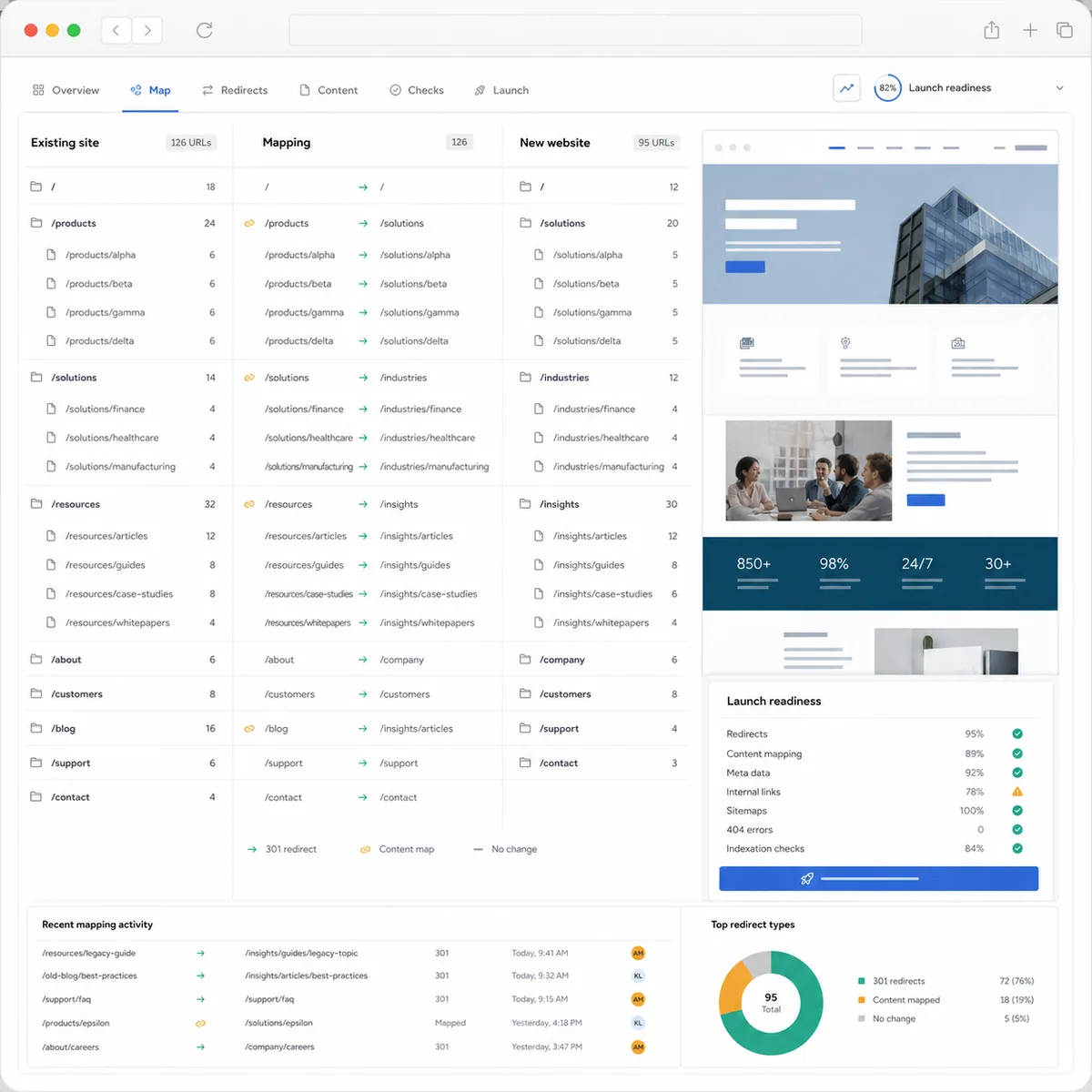
- Preserving Search Equity: We map 100% of historical URLs, title tags, meta descriptions, Open Graph data, and canonical declarations, establishing a strict 1-to-1 301 redirect map for any retired endpoints.
- Edge Rebuild & Form Decoupling: We construct clean, semantic HTML/CSS templates and route inquiry forms through secure serverless edge workers (incorporating anti-spam validation and direct CRM ingestion).
- Staging Acceptance & DNS Cutover: After automated Lighthouse CI verification and visual regression testing across mobile and desktop breakpoints, we update DNS records with zero downtime.
To evaluate whether an API-first rebuild or an optimized WordPress tuning makes sense for your business, explore our Website Design & Engineering services or review our transparent delivery process.