
Professional Services Website Design: How Specialist Firms Win Clients
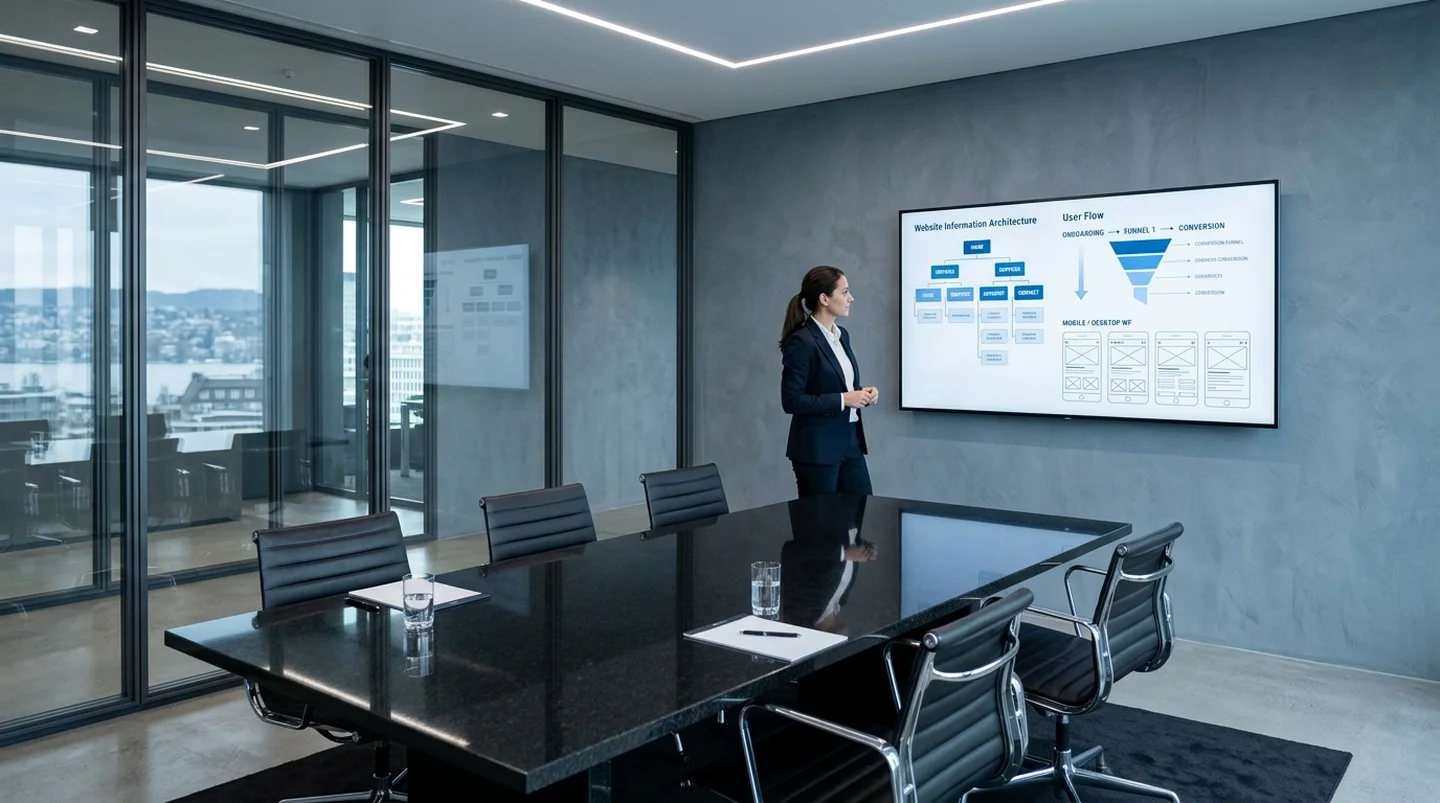
The referral paradox: your website is not an impulse storefront
If you run a boutique management consultancy, a specialized engineering firm, an IP legal practice, or a high-end technical studio, you already know where your best clients come from. They do not click on impulse display banners or browse coupon sites. Over 80% of high-value service engagements originate through word-of-mouth recommendations, peer referrals, or direct executive introductions.
When partners hear this, they often conclude: "Our business is entirely referral-driven, so our website doesn't really matter."
This is a costly misunderstanding. In reality, modern high-stakes buyers never hire an advisory firm purely on a colleague's verbal recommendation. The moment your firm’s name is mentioned, the buyer opens a browser and conducts digital due diligence. They are not visiting your site to be "entertained"—they are looking for confirmation that you are legitimate, specialized, and safe to recommend to their Board or CFO.
✦ The primary mission of a professional services website: De-risk the buying decision. The site exists to convert warm referral interest into qualified, high-conviction consultations by proving domain mastery and eliminating procurement hesitation.
The three due-diligence traps that kill referral conversions
When an executive lands on your website during a diligence review, three common architectural mistakes immediately erode credibility:
1. The Omnicompetent Generalist Trap
In an effort not to miss any potential business, firms list twenty disparate services on their homepage: "Strategy, Cloud Transformation, AI Advisory, Staff Augmentation, UI Design, Brand Identity, and Supply Chain Auditing." To an enterprise VP, claiming equal mastery across everything signals mastery of nothing. High-trust buyers seek specialists who have solved their specific operational pathology a dozen times, not generalist agencies learning on their billable hours.
2. The Corporate Stock Photo Cliché
Nothing screams "amateur intermediary" faster than full-width stock photos of smiling models in crisp suits shaking hands in front of blue glass skyscrapers. Sophisticated buyers recognize royalty-free stock imagery instantly. It conveys that your firm either lacks real people, lacks confidence in its physical presence, or hides behind an impersonal corporate veneer.
3. The Vague, Fluffy Case Study
Case studies that read: "We partnered with a Fortune 500 company to reimagine their agile digital synergy" provide zero evidentiary value. When an enterprise buyer investigates your past work, they want to understand the exact technical constraints, the institutional friction you navigated, and the measurable business outcome achieved.
The 4-part information architecture that wins specialist clients
| Architectural Element | Buyer Question Answered | Production Standard |
|---|---|---|
| Positioning Headline | "Are we in the right place?" | Direct problem statement; zero jargon; explicitly names target industry and operational tier. |
| Service Practice Pages | "Have you solved our specific problem?" | Granular breakdown of scope boundaries, deliverables, timeline, and what is excluded. |
| Evidentiary Case Studies | "Can you actually pull this off?" | Structured: Initial Pathology → Technical Friction → Exact Intervention → Hard Metrics. |
| Direct Partner Profiles | "Who is personally responsible for our work?" | Named principals with genuine technical credentials, published research, and contact paths. |
How to write unassailable case studies under strict NDAs
The most common objection specialist firms have to publishing proof is: "We cannot disclose our clients' names due to strict non-disclosure agreements." You do not need to reveal proprietary company names to prove authoritative competence. In fact, an anonymous, highly specific teardown often carries more authority than a glossy brand logo with no details.
Structure your case studies using the four-stage forensic model:
- The Operational Pathology: Describe the client's initial state with concrete parameters (e.g., "A Tier-1 European automotive supplier with 4 production facilities faced recurring 18% scrap rates due to legacy PLC synchronization drift.").
- The Constraints & Friction: Explain why simple solutions failed (e.g., "Halting the assembly line cost €45,000 per hour; any sensor retrofit had to occur within scheduled 4-hour weekend maintenance windows without altering existing fieldbus wiring.").
- The Specific Intervention: Detail the methodology applied (e.g., "We engineered an isolated edge gateway running real-time MQTT telemetry that captured microsecond jitter without placing load on the main SCADA network.").
- The Quantifiable Delta: State the measurable outcome (e.g., "Scrap rates dropped to 1.8% across 6 months, generating €1.4M in annual materials savings.").
Any technical director reading that teardown immediately recognizes real-world operational scar tissue. It instantly distinguishes your firm from marketing vendors who merely produce slides.
Designing the low-friction executive inquiry flow
Executive prospects do not want to fill out a 14-field form demanding their annual marketing budget, company size, and physical mailing address. Nor do they want an aggressive AI chatbot jumping onto their screen within 5 seconds of arrival.
Keep your inquiry path respectful and efficient:
- Contextual Intake: Ask 3 essential questions: Name & Work Email, Current Operational Challenge / Problem, and Target Engagement Timeline.
- Direct Response Expectation: State explicitly who will reply (e.g., "You will receive a direct technical response from a Principal Systems Lead within one business day, not a sales representative.").
- Frictionless NDA Protocol: Include a clear note or downloadable standard mutual NDA for enterprise procurement teams who require confidentiality prior to initial discovery calls.
Engineered for executive speed and accessibility
Decision-makers frequently review prospective partners on mobile devices during travel or between meetings. If your website takes 4 seconds to load over 4G networks or features sticky navigation banners that obscure 40% of the screen, they will hit the back button and proceed to the next firm on their referral list.
We build professional services websites with zero bloated plugins, static edge delivery, and sub-100ms global response times. Explore our B2B Website Design & Development services or review our Agency Selection Guide to evaluate your options.